Saturday, 12 November 2016

...the Afflicted Man's Companion


This work from 1800 is not, as might be supposed, a medical textbook. Rather it is essentially a religious tome containing numerous injunctions to stoicism in the face of illness and infirmity.

An extract reads, "Be not anxious for recovery to health; but leave the issue of the present sickness to the will and pleasure of the infinitely wise God."

It was written by the evangelical minister John Willison and first published in 1737, remaining in print for more than a century.

See Wikipedia: https://en.wikipedia.org/wiki/John_Willison

 This particular book was presented to Miss Mary Gilmour on 13 July 1819, and we can only speculate on the reason for someone choosing such a gift.

Monday, 7 November 2016

...a family portrait

By Edwardian times, when this photograph of an anonymous group was taken, the average size of family had already shrunk to just three children. So, to raise nine children was by then untypical. (I've assumed these are all the offspring of the seated patriarch and matriarch, as their distinctive chins would suggest.)

Today, in some developed countries - Germany is one example - the birth rate has fallen below what is considered to be the replacement ratio of 2.1 children. In Japan it is said to have reached a rather alarming 1.5, and is expected to result in a rapidly declining population over the next few decades, despite life expectancy continuing to increase, which naturally acts in the opposite direction, to shore up the level of population.

The current world population of 7.3 billion is increasing by around eighty million a year, and on some predictions will reach 9.7 billion by 2050. After that, however, some predict it will fall because of declining birth rates. Just how rapidly it falls, if at all, may depend on how successful (if that is the correct word) medical science proves at extending lifespan. The question is often put. Might future generations live typically to 200, or beyond ?


Friday, 4 November 2016

...a Russian tinplate toy

This wind-up Russian tinplate toy dates from around 1990, which indicates just how recently the (then) Soviet Union was producing these sharp-edged playthings. With a bit of encouragement it still hops.
The word on the little cardboard box simply says Frog.


Tuesday, 1 November 2016

...comic examples of corporal punishment

Is it ever acceptable to discipline children by beating them? It is apparently still just about legal in the UK. And why are comic depictions of it considered humorous?

This anthropomorphic example is from 1910.

And the following example is from a 1970's Beano comic.


Saturday, 29 October 2016

...a postcard of New Street station Birmingham

This postcard, which dates from around 1900 and doubles as a birthday card, shows activity at New Street station, Birmingham. The staff appear to have paused for the photograph, whilst the passengers have not. The time was precisely...er...oh dear. Either the hands have dropped off the clock, or they have moved too swiftly to be captured on camera.

The tower, top left, is a mystery to me.

Wednesday, 26 October 2016

...Driving Test Failure Form

This is a driving test failure form from the mid 1960's These were normally handed to the applicant at the end of the test by the examiner with the dreaded words, "I'm sorry to tell you that on this occasion you have not reached the required standard.." Alternatively, if you had passed your test, you would be given a pink slip together with a comment such as, "I am pleased to tell you..."

I have removed the name and address of the candidate on this form for reasons of privacy. The person involved failed their driving test for improper use of mirrors, and then discarded the form, as its somewhat crumpled appearance attests.

Compulsory driving tests were introduced by the Road Traffic Act of 1934, but suspended during the Second World War. There are, therefore, still licenced drivers on the roads today who have not taken a driving test, as they learned to drive during the war, often for military purposes.


Sunday, 23 October 2016

...promotional postcards early 1900's

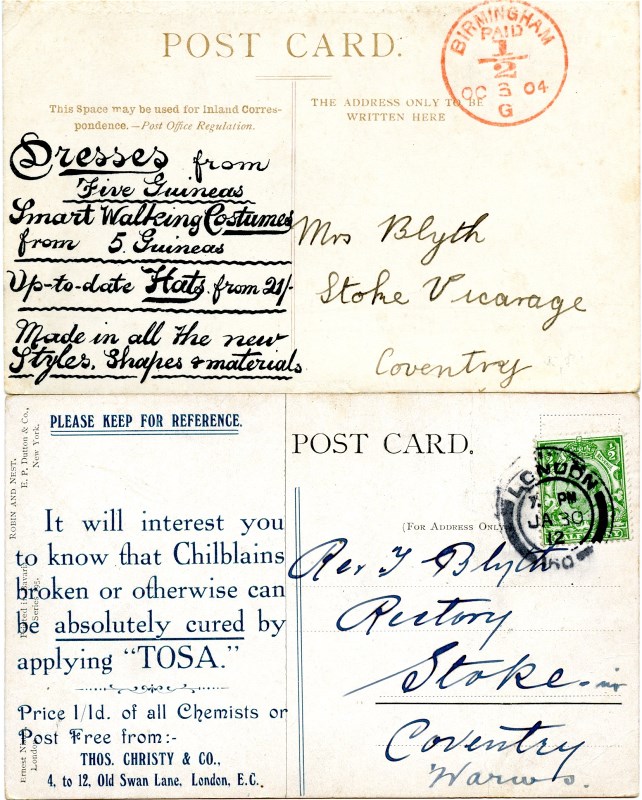
How did you get your advertising message across a hundred years ago? By placing adverts in newspapers and periodicals. But also, as now, by direct mail, especially to the more prosperous classes.

These four cards, dating from 1904-1912 were sent to a vicar and his wife, promoting Indian tea, Madame Howe's Birmingham clothing emporium, Malvern open gardens and a chilblain remedy.

This method capitalized on the cheap and speedy postal system.