Tuesday, 11 April 2017
...an Easter Postcard
It was once common in Britain to send greetings to friends and family, not just on birthdays and at Christmas but at Easter too. This card was sent during the First World War to Miss Betty Blyth, a vicar's daughter, by her Aunt Florence. It is a French produced postcard, overprinted with English words. The goat is presumably anticipating a meal.
Wednesday, 22 March 2017
..a wasp's nest
This extremely fragile wasp nest was built inside a bird box, and attached to the underside of the roof by the little projection just visible on the bottom left of the photograph below.
This nest was not made by the common wasp, which is far too large, but by one of the many smaller varieties of wasp.
There are said to be as many as 9000 different species in the UK, though there are only a small number of paper wasps, as in this example. Wasps that make a paper nest can often be seen scraping pieces of wood at nest-building time.
This nest was not made by the common wasp, which is far too large, but by one of the many smaller varieties of wasp.
There are said to be as many as 9000 different species in the UK, though there are only a small number of paper wasps, as in this example. Wasps that make a paper nest can often be seen scraping pieces of wood at nest-building time.
Saturday, 11 March 2017
...a postage stamp celebrating votes for women
This 1968 postage stamp commemorated the fiftieth anniversary of granting the right to vote to women over the age of thirty who met certain minimum property qualifications. Next year will witness a hundred years since this momentous change.
The stamp shows the statue of campaigner Emmeline Pankhurst (1858-1928) which stands at the entrance to Victoria Tower Gardens in London.
Eight million women gained the right to vote in elections through the 1918 Representation of the People's Act. What is less well known is that five million previously disenfranchised men over the age of twenty-one also won the right to vote at the same time, mainly non-householders such as adult children living with parents. Indeed, many of the brave soldiers who fought and died during the Great War (1914-18) would have been either too young to vote, or disbarred from doing so.
Women finally achieved voting parity with men ten years later, in 1928, when the voting age was equalized at twenty-one.
The stamp shows the statue of campaigner Emmeline Pankhurst (1858-1928) which stands at the entrance to Victoria Tower Gardens in London.
Eight million women gained the right to vote in elections through the 1918 Representation of the People's Act. What is less well known is that five million previously disenfranchised men over the age of twenty-one also won the right to vote at the same time, mainly non-householders such as adult children living with parents. Indeed, many of the brave soldiers who fought and died during the Great War (1914-18) would have been either too young to vote, or disbarred from doing so.
Women finally achieved voting parity with men ten years later, in 1928, when the voting age was equalized at twenty-one.
Saturday, 4 March 2017
..an 1970 live album by Melanie Safka
Channeling the spirit of the 1960's, hippies, incense and flower power was American singer-songwriter Melanie Anne Safka, who famously performed in the pouring rain aged just 22 at the 1969 Woodstock festival, for which she was paid $750.
Her hits included "Ruby Tuesday", "Brand New Key", "Lay Down (Candles in the Rain)", and this song performed against the backdrop of the Vietnam War.
https://www.youtube.com/watch?v=ZPPEkuPOd_s
Her hits included "Ruby Tuesday", "Brand New Key", "Lay Down (Candles in the Rain)", and this song performed against the backdrop of the Vietnam War.
https://www.youtube.com/watch?v=ZPPEkuPOd_s
Monday, 27 February 2017
..a Bush DAC11 Radio
This is a professionally refurbished 1950's Bush DAC11 valve radio, of a type once owned by my family.
This particular brand of radio was introduced by Bush in June 1949, and was sold for the sum of £17.13s.6d (£17.67) plus Purchase Tax, the forerunner to Value Added Tax. Purchase Tax varied from item to item, and was higher on goods considered luxuries. One source suggests the final selling price for this radio was around £22.
The sets are not rare or valuable, and often come for sale, though it is wise, if bought at auction, to have the set professionally checked. Bakelite radios tend to be more popular with collectors, and command slightly better prices than those with wooden cabinets such as this one.
Saturday, 18 February 2017
...advertising in a Conan Doyle novel
This cheap edition of a Conan Doyle novel was published in 1901, ten years after first being serialized in the Cornhill Magazine. It is a medieval adventure story set at the time of the Hundred Years War with France (1337-1453), and therefore a significant departure from his Sherlock Holmes stories.
Cheaply produced books of this kind were often partly financed by advertising, and it is that which this blog focusses upon. The range of products advertised varied, but frequently related to the relief of ailments. Above is an advert for Sunlight soap, which was promoted specifically for cleaning clothes and linen. It shows a young woman (servant?) in a snow filled landscape.
Below is an advert for a popular patent medicine designed to relieve a wide variety of pains and discomforts. It is described as "a great specific for cholera, dysentery, diarrhoea". The brand name Chlorodyne gives little hint of its active ingredients which were chloroform, cannabis and laudanum, another name for opium.
Below is an advert for Fry's cocoa, which like many food products was also promoted as having potential medical benefits.
We then have an advertisement for Birkbeck Bank which was paying a generous two percent interest on both current and deposit accounts. Oh, would those days return! Actually, ten years later the bank went into receivership, and depositors got only half their money back. That surely provided a lasting lesson for the banking community. And on the same page, yet another medical advert, this time for multipurpose pills.
Below, another aid to health, capable it claims of dealing with such impostions as a "temporary congestion arising from alcoholic beverages", "biliousness", "oppression", and "nettle rash".
And finally, when hopefully you are fully recovered from your ills, why not visit the showrooms of Oetzmann & Co., for some modestly priced furniture?
Cheaply produced books of this kind were often partly financed by advertising, and it is that which this blog focusses upon. The range of products advertised varied, but frequently related to the relief of ailments. Above is an advert for Sunlight soap, which was promoted specifically for cleaning clothes and linen. It shows a young woman (servant?) in a snow filled landscape.
Below is an advert for a popular patent medicine designed to relieve a wide variety of pains and discomforts. It is described as "a great specific for cholera, dysentery, diarrhoea". The brand name Chlorodyne gives little hint of its active ingredients which were chloroform, cannabis and laudanum, another name for opium.
Below is an advert for Fry's cocoa, which like many food products was also promoted as having potential medical benefits.
We then have an advertisement for Birkbeck Bank which was paying a generous two percent interest on both current and deposit accounts. Oh, would those days return! Actually, ten years later the bank went into receivership, and depositors got only half their money back. That surely provided a lasting lesson for the banking community. And on the same page, yet another medical advert, this time for multipurpose pills.
Below, another aid to health, capable it claims of dealing with such impostions as a "temporary congestion arising from alcoholic beverages", "biliousness", "oppression", and "nettle rash".
And finally, when hopefully you are fully recovered from your ills, why not visit the showrooms of Oetzmann & Co., for some modestly priced furniture?
Sunday, 12 February 2017
...the life story of Charles Peace
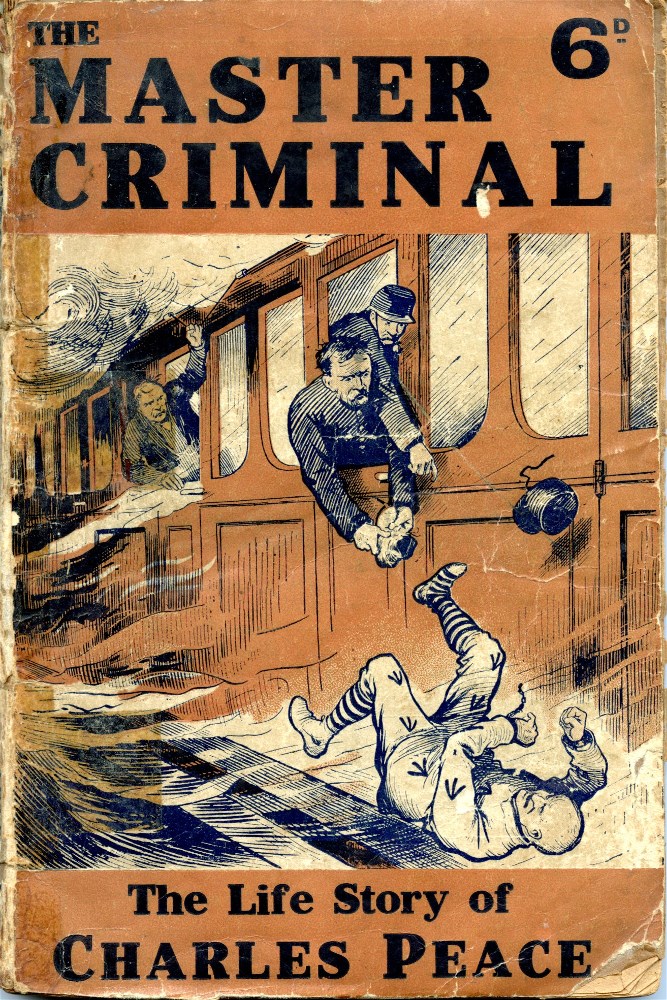
This sixpenny (2½p) Edwardian book tells the stirring tale of the life of so-called master criminal Charles Peace (1832-1879). The cover shows his failed attempt to escape from custody by leaping from a moving train.
Printed cheaply, on paper that is now brown and crumbling, books of this kind fed a popular interest in crime, which continues unabated today. Recent publications, as the inside cover noted, included a first-hand account by the American born murderess Florence Maybrick, who was convicted of killing her husband, and released from prison in 1904 after a fifteen year incarceration, and the story of John Lee, "the man they could not hang", both of whom merit their own Wikipedia page, along with Charles Peace
https://en.wikipedia.org/wiki/Charles_Peace
Peace was a petty thief, burglar and double murderer who would hardly seem to warrant his notoriety, for, although a career criminal, he was certainly not a "master criminal". But his early inclusion as a wax exhibit at Madame Tussauds Chamber of Horrors, which showed him at his execution, as well as several instant books and articles recording, and perhaps embroidering, his exploits, and frequent repetition of the same in later compilations of the lives of victorian criminals, together, I suspect, with a fascination with his rather unique and villanous appearance, served to guarantee his lasting fame.
A police description given of Peace was as follows: "He is thin and slightly built, from fifty-five to sixty years of age [he was actually forty-five], five feet four inches or five high, grey (nearly white) hair, beard and whiskers...He lacks one or more fingers off the left hand, walks with his legs rather wide apart, speaks rather peculiarly as though his tongue was too large for his mouth, and is a great boaster..."
This account of his life and exploits is only sparsely illustrated, and the text contains some dubiously precise examples of conversations supposedly made, but the story is nevertheless well written and eminently readable. In this illustration, Peace is challenged by a servant whilst committing a burglary.
Here Peace grapples with fellow prisoner Sims who has betrayed him over some matter.
And in the final scene, Peace is shown at his trial being sentenced to death for the murder of his neighbour Albert Dyson, with whose wife he had become unnaturally obsessed. He later confessed to the earlier murder of Police Constable Nicholas Cock, for which another man had been wrongly convicted and sentenced to life imprisonment.
Peace was executed at Armley Jail, Leeds on the 25th February 1879, before which he penned several letters to family and friends including the following to his brother.
"Dear Brother, I write to you hoping you will take this as a warning from the scaffold. as I intend it to be handed to my chaplain when upon the scaffold the moment before I die. I am sorry to say that I have been a very bad, base, and wicked man the whole course of my life. None but God and myself know the extent of my terrible deeds. And what has it all profited me now? Oh, let me beg of you in my last moments to give yourself to God and try and walk in the narrow path that leads to eternal life. And may the great God in His merciful goodness pardon all of your sins, and may we all meet in the end at His right hand in glory...That these few lines may have the desired effect upon you is the dying prayer of Your Brother."
It was salutary advice to all brothers to steer away from the path of evil!
Printed cheaply, on paper that is now brown and crumbling, books of this kind fed a popular interest in crime, which continues unabated today. Recent publications, as the inside cover noted, included a first-hand account by the American born murderess Florence Maybrick, who was convicted of killing her husband, and released from prison in 1904 after a fifteen year incarceration, and the story of John Lee, "the man they could not hang", both of whom merit their own Wikipedia page, along with Charles Peace
https://en.wikipedia.org/wiki/Charles_Peace
Peace was a petty thief, burglar and double murderer who would hardly seem to warrant his notoriety, for, although a career criminal, he was certainly not a "master criminal". But his early inclusion as a wax exhibit at Madame Tussauds Chamber of Horrors, which showed him at his execution, as well as several instant books and articles recording, and perhaps embroidering, his exploits, and frequent repetition of the same in later compilations of the lives of victorian criminals, together, I suspect, with a fascination with his rather unique and villanous appearance, served to guarantee his lasting fame.
A police description given of Peace was as follows: "He is thin and slightly built, from fifty-five to sixty years of age [he was actually forty-five], five feet four inches or five high, grey (nearly white) hair, beard and whiskers...He lacks one or more fingers off the left hand, walks with his legs rather wide apart, speaks rather peculiarly as though his tongue was too large for his mouth, and is a great boaster..."
This account of his life and exploits is only sparsely illustrated, and the text contains some dubiously precise examples of conversations supposedly made, but the story is nevertheless well written and eminently readable. In this illustration, Peace is challenged by a servant whilst committing a burglary.
Here Peace grapples with fellow prisoner Sims who has betrayed him over some matter.
And in the final scene, Peace is shown at his trial being sentenced to death for the murder of his neighbour Albert Dyson, with whose wife he had become unnaturally obsessed. He later confessed to the earlier murder of Police Constable Nicholas Cock, for which another man had been wrongly convicted and sentenced to life imprisonment.
Peace was executed at Armley Jail, Leeds on the 25th February 1879, before which he penned several letters to family and friends including the following to his brother.
"Dear Brother, I write to you hoping you will take this as a warning from the scaffold. as I intend it to be handed to my chaplain when upon the scaffold the moment before I die. I am sorry to say that I have been a very bad, base, and wicked man the whole course of my life. None but God and myself know the extent of my terrible deeds. And what has it all profited me now? Oh, let me beg of you in my last moments to give yourself to God and try and walk in the narrow path that leads to eternal life. And may the great God in His merciful goodness pardon all of your sins, and may we all meet in the end at His right hand in glory...That these few lines may have the desired effect upon you is the dying prayer of Your Brother."
It was salutary advice to all brothers to steer away from the path of evil!
Wednesday, 8 February 2017
...a postcard of Weston-Super-Mare pier
The Grand Pier at Weston-Super-Mare was opened in 1904, as this contemporary postcard (above) shows.
It had a successful history despite being damaged by fire in 1930, but was then utterly destroyed in a conflagration in 2008.
This Wikipedia link tells of the pier's history, and shows a dramatic picture of it ablaze.
https://en.wikipedia.org/wiki/Grand_Pier,_Weston-super-Mare
It has since been rebuilt at great cost, and is now a great addition to the town.
Sunday, 22 January 2017
...cycling proficiency tests
This enamel badge and the aluminium roundel, (which one would fix via a bracket to the handlebars) along with a paper certificate - temporarily mislaid - were awarded for passing a cycling proficiency test in the 1960's, which included basic knowledge of bike maintenence, correct use of gears and hazard awareness.
The Cycling Proficiency Test was created by RoSPA in 1947 as a minimum recommended standard for cycling on British roads. The National Cycling Proficiency Scheme was introduced by the Government in 1958, with statutory responsibility for road safety being given to local authorities in 1974, including the provision of child cyclist training but the scheme continued to be associated with RoSPA. The scheme was superseded by the National Standards for Cycle Training branded Bikeability in England.(Retreived from Wikipedia)
Monday, 16 January 2017
...a German banknote
This is a banknote from the hyperinflationary period of the German Weimar Republic.
https://en.wikipedia.org/wiki/Hyperinflation_in_the_Weimar_Republic
It has been used ignominiously by a carpenter as a scribbling pad.
Other countries have suffered periods of severe inflation, often when their Governments resorted to creating, and often literally printing, currency to pay their debts. Done in a measured way, such as through Quantitative Easing, it can successfully revive an economy.
https://en.wikipedia.org/wiki/Quantitative_easing
Done irresponsibly, as in Zimbabwe or Venezuela, it can result in a complete undermining of the currency. Zimbabwe essentially abandoned the Zimbabwe Dollar in 2009, and now uses the currencies of other countries, notably the South African Rand.
https://en.wikipedia.org/wiki/Zimbabwean_dollar
Wednesday, 4 January 2017
...a 1912 Rover Motorcycle
A crowd gathers in 1912 at an unknown location to admire a Rover Motorcycle, possibly one of the new 3 speed models with spring-loaded tappets (whatever that means).
https://en.wikipedia.org/wiki/Rover_(motorcycles)
Wednesday, 28 December 2016
...a Status Quo concert ticket
A Status Quo concert ticket from 23rd December 1972. This was the year of their first truly successful album Piledriver, released just a week before this concert, with the classic lineup up of Rossi, Parfitt, Lancaster and Coughlan.
It included the track Paper Plane, which became a hit single.
https://www.youtube.com/watch?v=KhwCqAmggnM
Saturday, 24 December 2016
...a ninety-nine year old Christmas gift
"To my dear sweetheart. Wishing you a happy Christmas. Your loving husband Fred. 24th Dec. 1917."
We shall never know the identity of this affectionate couple, who have doubtless long-since departed this world. But this touching expression of sentiment remains.
Among this anthology of Longfellow's poems is his marvellous Psalm of Life.
Lives of great men all remind us
We can make our lives sublime,
And, departing, leave behind us
Footprints on the sands of time
Tuesday, 20 December 2016
...the continuing conflict
Christmas 1916 was a miserable one for the progress of the War, with the bloody Battles of the Somme and Verdun barely over, and the 1915 Battle of Champagne - to which this postcard refers, and during which some fifty thousand died - by then just a distant memory.
There was no Christmas truce in the trenches this year, as there had been in 1914, and even in a few places in 1915.
"The War to end all wars" ground on.
Friday, 16 December 2016
...Edwardian Christmas Postcard
It is generally accepted that the modern Christmas celebration, of cards, decorated fir trees, carols and exchanges of presents, was a Victorian invention. Indeed, it is sometimes said that Victoria's consort, Prince Albert, was largely responsible for popularising the traditions. Others credit the influence of Charles Dickens' immensely successful 1843 novella A Christmas Carol. What do I think of Christmas? Do I say "Bah Humbug"? No, I say "God bless us everyone".
Monday, 12 December 2016
...a concert ticket
This concert at the Crystal Palace Bowl in June 1972 was not exactly a washout, but those of us who came unprepared for a not untypical British summer's day suffered a real soaking from a thunderstorm.
The line-up of groups was great: Joe Cocker, Richie Havens, The Beach Boys. But the day was cold and miserable and, as one young attendee reflected, there was a lack of any atmosphere.
http://www.ukrockfestivals.com/Garden-party-72.html
The whole concert was apparently filmed, but only extracts of it now seem to be available.
Here is taste of that day: https://youtu.be/uS6m0fN-Ow0
The line-up of groups was great: Joe Cocker, Richie Havens, The Beach Boys. But the day was cold and miserable and, as one young attendee reflected, there was a lack of any atmosphere.
http://www.ukrockfestivals.com/Garden-party-72.html
The whole concert was apparently filmed, but only extracts of it now seem to be available.
Here is taste of that day: https://youtu.be/uS6m0fN-Ow0
Sunday, 4 December 2016
...Royal Engineers' insignia
Here is another mystery. This is Royal Engineers insignia from the Second World War. But what is the significance of the warthog, since I can find no reference connecting it to the Royal Engineers?
Did the different companies of Engineers have different emblems?
Wednesday, 30 November 2016
...a mystery float
Here is a photograph dating from the early years of the twentieth century. Who were these people? Why had they decorated a float? Were they participating in a parade? There are no real clues in the photograph, except that they had paused on the road near a church or chapel, and that all were dressed in their best, other than the bearded gentleman holding the horse.
Sunday, 27 November 2016
...German minefield Flag
This wartime souvenir was a marker for German minefields during the Second World War.
It is stamped RLM for Reich Air Ministry, the Reichsluftfahrtministerium, which is a slight puzzle, though the person who acquired it did visit the V2 rocket launch site at Cuxhaven, Germany, in 1945 and may have collected it there.
The Germans used a variety of signs to mark minefields, usually with a skull and crossed bones, including a triangular cloth version of this sign.
It is stamped RLM for Reich Air Ministry, the Reichsluftfahrtministerium, which is a slight puzzle, though the person who acquired it did visit the V2 rocket launch site at Cuxhaven, Germany, in 1945 and may have collected it there.
The Germans used a variety of signs to mark minefields, usually with a skull and crossed bones, including a triangular cloth version of this sign.
Thursday, 24 November 2016
...Royal signatures
This insert from a Christmas card sent in 1939 by King George VI and Queen Elizabeth was rescued from a waste paper bin, hence the cigarette burn.
By legend, the card - of which the picture part is missing - was sent to a close relative of Queen Elizabeth, the mother of our present Queen.
Then, as now, it was common for royal signatures to be done by an autopen machine, since so many royal signatures were required. And it is possible that the King's signature here was done in that manner. However, it is likely that the card was genuinely signed by Queen Elizabeth because she omitted the letter "R" for Regina from the end of her name, which you normally see on her autopen signature, and one would expect that a card sent to (say) a sister, aunt or cousin to be personally signed.
By legend, the card - of which the picture part is missing - was sent to a close relative of Queen Elizabeth, the mother of our present Queen.
Then, as now, it was common for royal signatures to be done by an autopen machine, since so many royal signatures were required. And it is possible that the King's signature here was done in that manner. However, it is likely that the card was genuinely signed by Queen Elizabeth because she omitted the letter "R" for Regina from the end of her name, which you normally see on her autopen signature, and one would expect that a card sent to (say) a sister, aunt or cousin to be personally signed.
Subscribe to:
Posts (Atom)